








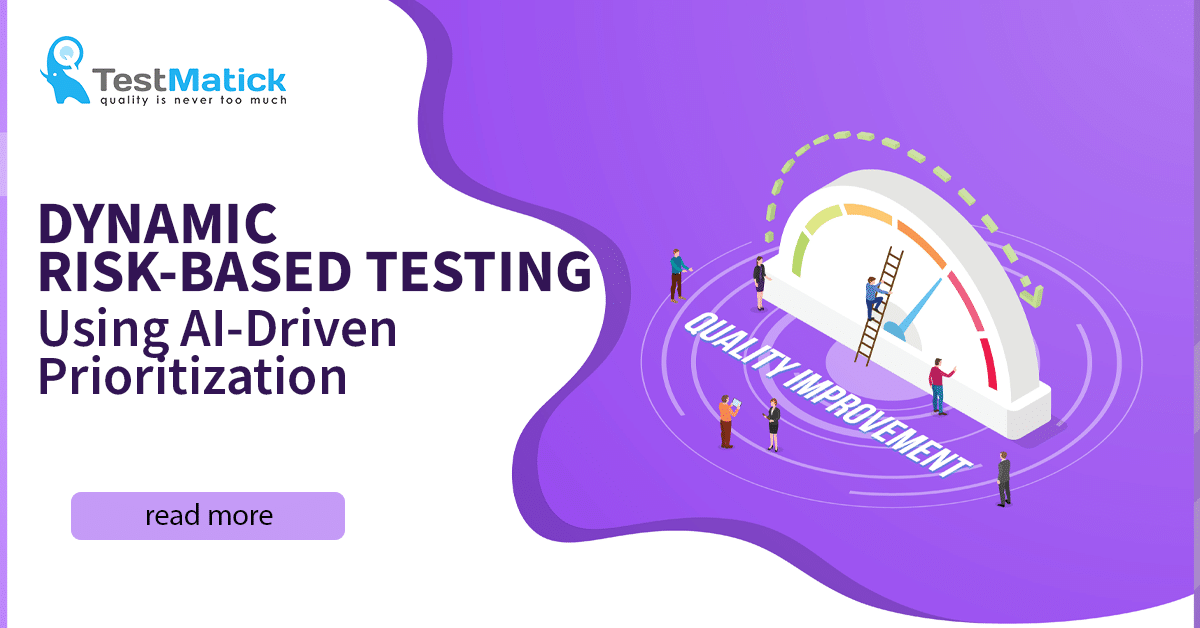
As software systems grow increasingly complex and change at lightning speed, conventional risk-based testing can quickly fall behind. Test priorities set at the outset of a development cycle may lose relevance as user interactions evolve, integrations encounter failures, or fresh production data uncovers unexpected risks. What seemed like a solid test plan on day one can become misaligned with the product’s actual behavior within days.
This is where dynamic, AI-driven risk-based testing becomes essential. Instead of relying purely on intuition or experience, teams can continuously re-evaluate risk using real-time signals from production and development. Machine learning models digest telemetry, code changes, defect trends, usage patterns, and performance data – and test priorities automatically adjust as conditions evolve.
Why Static Prioritization Falls Short
Traditional RBT aims to focus testing where it matters most, but in practice it often predicts rather than responds. A feature that appears low-risk during planning may become unstable after a busy weekend or following a minor code change. Conversely, some areas lose relevance but remain on the “high priority” list simply because they were labeled that way earlier.
Manual prioritization is slow, subjective, and often disconnected from actual system behavior. It doesn’t scale well in distributed or event-driven architectures, where risk emerges dynamically and unpredictably. Dynamic RBT solves this by grounding all decisions in real-time evidence instead of outdated assumptions.
How AI-Driven Dynamic RBT Works
Dynamic RBT relies on continuous data aggregation. Machine learning models collect information from production telemetry, analytics, logs, version control, and past test results. Based on this data, the system assigns constantly updated risk scores to each component.
Every test case is mapped to a particular feature or module. When a component’s risk score changes – due to increased traffic, new defects, performance degradation, or a critical code commit – the system automatically adjusts the priority of associated tests. The test suite stays perfectly aligned with how the product behaves right now.
When integrated into CI/CD pipelines, this becomes even more powerful. Every merge, deployment, or anomaly triggers a recalculation. Testers no longer update spreadsheets or static matrices – the system handles reprioritization continuously and intelligently.
Example: Live Risk Shift in a Banking App
A banking app is preparing for a routine release. In the past 24 hours, telemetry shows an increase in login errors on a specific device model. Monitoring tools report slow responses on the balance-check endpoint. Meanwhile, a promotional campaign has driven up traffic in money-transfer flows.
An ML-based risk model detects these patterns instantly. It elevates authentication and transfer scenarios to the top of the regression suite, while deprioritizing less critical areas, such as profile updates. The QA team focuses exactly where the current risk is highest.
Key Value Gains
- Faster detection of critical defects as the test suite gravitates toward areas with emerging issues.
- Test coverage that mirrors real user behavior and live system conditions.
- More efficient regressions, since low-value tests naturally move down in priority.
- Higher release confidence because testing always reflects the true state of the product.
Challenges and Practical Considerations
Adopting dynamic RBT is not only a technical change – it also requires process maturity and organizational buy-in. Machine learning models depend on consistent, high-quality data. If telemetry, event tagging, or logs are incomplete, the model won’t generate reliable risk signals. Teams also need transparency: understanding why a test was reprioritized builds trust in the system.
Integration effort is another key factor. CI/CD pipelines, monitoring tools, version control systems, and test management platforms must communicate seamlessly. And culturally, teams must adapt to the idea that prioritization is no longer a manual task – it’s a continuous, data-driven process.
Recommended Adoption Steps
- Start small, applying dynamic RBT to a limited scope before scaling further.
- Create clear mappings between test cases and system components to ensure risk signals translate accurately.
- Monitor and retrain the model regularly to maintain accuracy and relevance.
- Automate reprioritization triggers so risk updates occur after every deployment, code change, or anomaly.
Conclusion
Dynamic, AI-driven risk-based testing represents a major evolution in QA strategy. Rather than depending on rigid planning cycles, teams gain the ability to react instantly to real-time product conditions. As user behavior, performance metrics, and business priorities shift, the test suite adapts automatically – keeping attention focused on the areas with the highest impact. Organizations that embrace this approach detect critical defects earlier, reduce regression overhead, and release with significantly greater confidence. For QA teams looking to modernize and operate with true agility, dynamic RBT is no longer optional – it’s becoming a competitive necessity.




0 Comments