








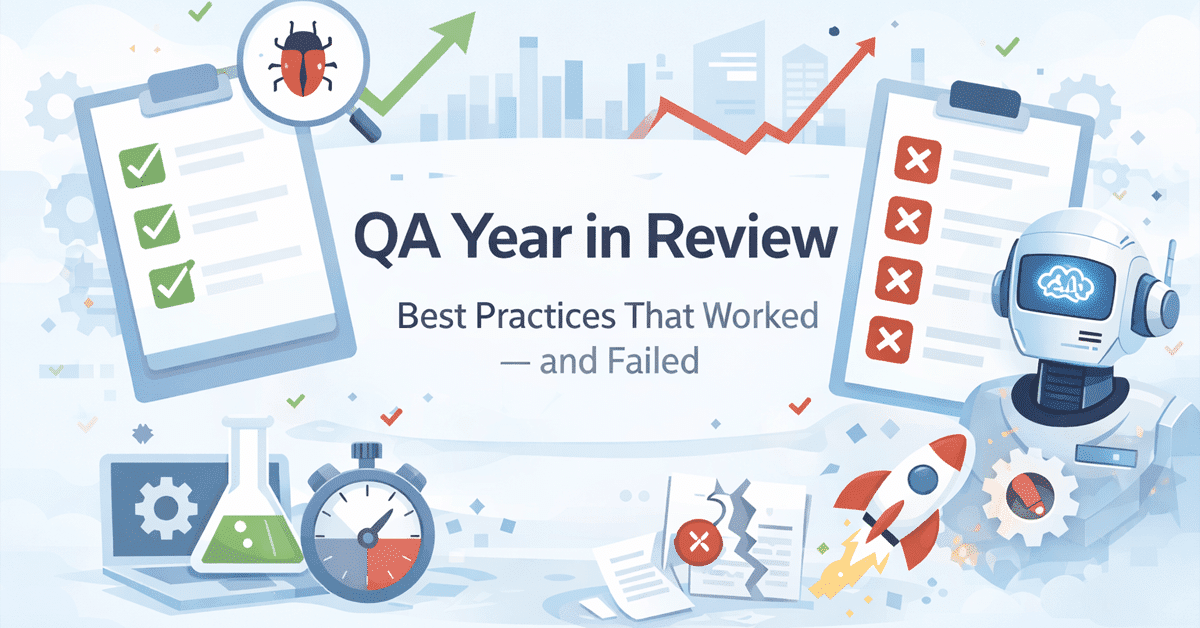
The end of the year is traditionally a time for summaries and forecasts. In software quality assurance, however, reflection is not just a formality – it is a necessity. This year’s software quality assurance trends showed that while QA practices continue to evolve, not all changes lead to better quality. Some approaches mature and prove their value, while others quietly fail, often repeating the same mistakes under new names.
This article looks back at the past year in QA from a practical, analytical perspective: which quality assurance strategies genuinely helped teams deliver better software, and which ones created an illusion of quality rather than real results.
Quality as a Shared Responsibility: A Key QA Best Practice
✅ What worked
- Earlier involvement of QA in planning and refinement
- Testers contributing to requirement clarity, risk analysis, and acceptance criteria
- Stronger collaboration between QA, developers, and product managers
Teams that embraced this QA best practice reduced late-stage surprises and production issues. Quality assurance was no longer limited to defect detection but actively helped prevent defects before development scaled.
❌ What didn’t
- Declaring “quality ownership” without changing processes
- Expecting developers to “handle testing” without time, tools, or guidance
- Removing QA roles while assuming automation or AI would compensate
When shared ownership existed only as a slogan, the result was usually lower visibility of risks rather than improved software quality.
Shift-Left Testing: Effective Only as a Risk-Based QA Strategy
Shift-left testing remained one of the most discussed software testing trends of the year. The concept itself is sound: address quality risks earlier, when changes are cheaper and easier.
✅ What worked
- Early risk-based test planning
- QA participation in architecture and design discussions
- Lightweight testability reviews before development started
Teams that applied shift-left as a risk-based testing strategy, rather than a scheduling change, saw tangible benefits: fewer critical defects downstream and stronger alignment with business goals.
❌ What didn’t
- Simply moving test execution earlier without changing strategy
- Running the same test cases sooner, without context
- Treating shift-left as “QA testing unfinished features”
Without a clear purpose, shift-left increased effort without increasing value.
Test Automation Strategy: Maturity Over Coverage
Test automation continued to be a core pillar of modern QA, but the past year confirmed that automation itself is no longer a competitive advantage. A thoughtful test automation strategy made the difference.
✅ What worked
- Automation aligned with risk and business-critical user flows
- Clear separation between fast feedback tests and deeper regression layers
- Maintenance-focused frameworks with realistic expectations
Well-designed automation supported confident releases and reduced manual effort where it mattered most.
❌ What didn’t
- Automating for coverage metrics rather than risk
- Treating automation as a replacement for testing thinking
- Underestimating maintenance costs and test data complexity
Many teams discovered that high automation coverage did not prevent production incidents — because the wrong scenarios were automated or automation was disconnected from real user behavior.
QA Metrics: When Measurement Hides Real Quality Risks
QA metrics were more visible to stakeholders this year, but visibility did not always translate into better decision-making.
✅ What worked
- Metrics analyzed as trends rather than isolated numbers
- Risk-based reporting instead of raw defect counts
- Linking QA metrics to business impact
When metrics were used as decision-support signals, they helped teams prioritize more effectively and communicate risk clearly.
❌ What didn’t
- Obsessing over test case counts or total bug numbers
- Comparing teams using identical metrics without context
- Optimizing metrics instead of actual quality outcomes
In many cases, QA metrics created a false sense of control, while real risks remained unaddressed.
AI in Software Testing: Helpful Assistant, Risky Authority
Interest in AI in software testing grew significantly this year, from test case generation to defect analysis. In practice, the results were mixed.
✅ What worked
- Using AI to support exploratory testing and analysis
- Accelerating repetitive QA tasks, not replacing human judgment
- Treating AI-generated output as input, not truth
When applied carefully, AI helped testers focus on higher-value analytical work.
❌ What didn’t
- Blind trust in AI-generated test cases
- Using AI to justify reduced testing effort
- Replacing domain knowledge with generic AI suggestions
The most successful teams treated AI as an assistant rather than a decision-maker.
Software Testing Challenges: The Persistent Speed vs. Quality Trade-Off
Despite years of discussion, many teams continued to frame quality assurance as something that slows delivery. This became especially visible toward the end of the year under deadline pressure.
✅ What worked
- Risk-based release decisions
- Transparent communication of quality trade-offs
- Explicit acknowledgment of technical and quality debt
❌ What didn’t
- Skipping testing “temporarily” to meet deadlines
- Treating hotfixes as a standard delivery strategy
- Accumulating invisible quality debt
In most cases, shortcuts taken for speed resulted in higher long-term costs – including maintenance effort, instability, and loss of user trust.
QA Process Improvement: Key Lessons for the Next Year
Looking back, one pattern stands out: tools and methodologies mattered far less than clarity of intent. Teams that understood why they applied certain QA practices consistently achieved better outcomes than those following trends mechanically.
The most effective QA approaches this year were:
- ✅ Context-driven, not checklist-based
- ✅ Risk-focused, not metric-driven
- ✅ Collaborative, not siloed
Quality improved not because teams tested more, but because they made better testing decisions.
Final Thoughts
End-of-year reflection in QA is not about declaring winners and losers among tools or frameworks. It is about recognizing which software quality assurance strategies helped teams manage risk and make better decisions – and which merely created the appearance of control.
As systems grow more complex and business expectations rise, quality can no longer be treated as a phase or a role. It must remain a continuous, conscious practice supported by experience, analysis, and collaboration.
At TestMatick, we consistently see the strongest results where QA is treated not as a cost or safety net, but as a strategic contributor to long-term product success.




0 Comments