






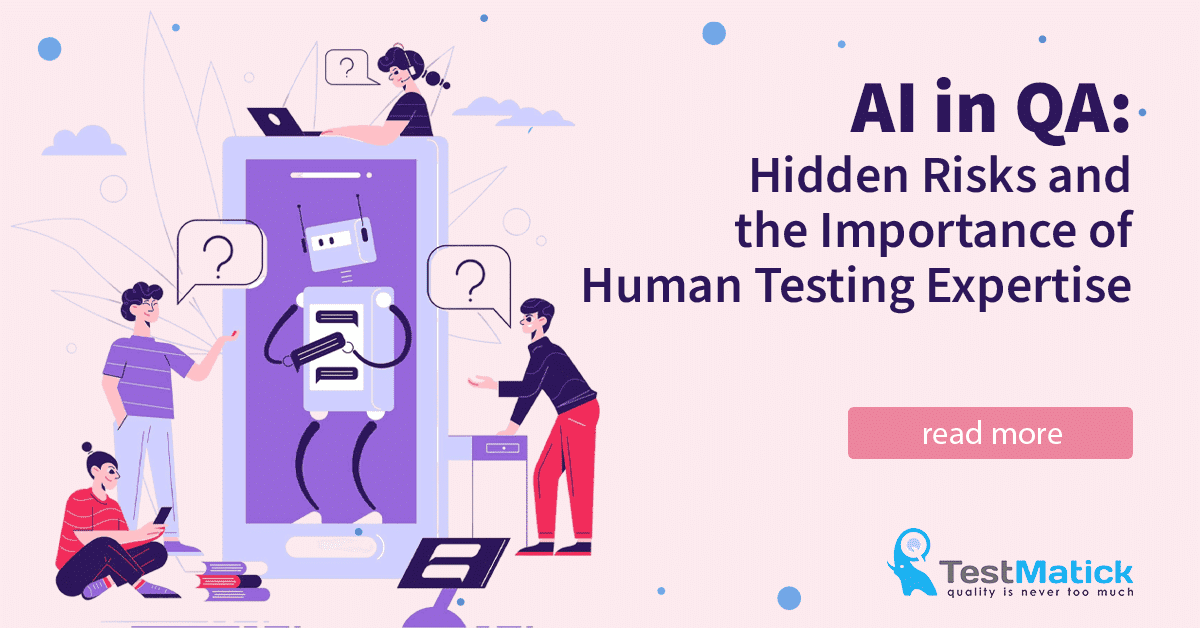
Finding the Right Balance Between Automation, AI-Driven Insights, and Human Expertise
Artificial Intelligence has rapidly become one of the most talked-about technologies in Quality Assurance. AI-powered test generation, self-healing automation, anomaly detection, and predictive analytics promise faster releases, lower costs, and fewer defects. For many teams, AI feels like the next logical evolution of test automation.
But while AI can significantly enhance QA processes, over-reliance on it introduces risks that are often overlooked. When AI is treated as a replacement rather than an assistant, quality suffers in subtle but dangerous ways.
In this article, we explore the hidden risks of depending too heavily on AI in QA – and why the most effective testing strategies are built on a balanced combination of automation, AI-driven analysis, and human expertise.
AI in QA: Powerful, but Not Infallible
AI excels at processing large volumes of data, identifying patterns, and optimizing repetitive tasks. In QA, this translates into:
- Faster test execution and maintenance
- Automated test case generation
- Detection of anomalies across logs, metrics, and traces
- Predictive insights based on historical data
These capabilities are valuable, especially for complex, fast-moving systems. However, AI systems learn from existing data and predefined objectives. They do not understand product intent, user frustration, or business risk in the way humans do.
When teams assume that AI-driven testing alone guarantees quality, they risk missing what matters most.
Risk #1: Optimizing for Metrics Instead of Real Quality
AI systems are designed to optimize what they can measure. In QA, that often means:
- Test coverage percentages
- Pass/fail rates
- Execution time
- Defect counts
While these metrics are useful, they are not equal to quality.
An AI model may improve coverage while generating shallow or redundant tests. It may reduce defect counts by focusing on low-risk areas while missing critical user flows. Over time, teams can end up with “healthy-looking” dashboards that hide real product issues.
Human testers bring context: they understand which failures are acceptable, which edge cases are dangerous, and which scenarios truly impact users and business outcomes.
Risk #2: Blind Spots in User Experience and Edge Cases
AI is excellent at identifying patterns – but users are unpredictable.
Unusual behavior, emotional reactions, accessibility challenges, and cultural nuances often fall outside the scope of AI-driven testing. Exploratory testing, usability testing, and scenario-based thinking require curiosity and empathy – qualities AI does not possess.
When QA teams rely too heavily on AI-generated tests, they risk validating only “expected” behavior, while missing:
- Confusing workflows
- Poor error messaging
- Accessibility barriers
- Edge cases caused by real-world usage
These are often the issues that generate the most support tickets and damage brand trust.
Risk #3: False Confidence in AI Recommendations
AI-based test analysis tools frequently provide insights such as:
- “Low risk change”
- “Test coverage is sufficient”
- “No anomalies detected”
While helpful, these recommendations are probabilistic, not guarantees. If teams accept them without critical review, they may skip necessary testing or release changes prematurely.
AI does not question assumptions. It does not challenge requirements. It does not ask, “Should this feature exist at all?” Human testers do.
The danger is not that AI makes mistakes – it’s that teams stop questioning its output.
Risk #4: Data Bias and Historical Limitations
AI models are only as good as the data they are trained on. If historical test data reflects past priorities, gaps, or flawed assumptions, AI will reinforce them.
Common consequences include:
- Repeating the same testing patterns while ignoring new risks
- Under-testing rarely used but business-critical features
- Missing issues introduced by architectural or usage shifts
As products evolve, relying on historical data alone can lock QA into outdated risk models. Human expertise is essential to reassess priorities as business goals, users, and technologies change.
Risk #5: Erosion of Critical QA Skills
When AI takes over decision-making, teams may gradually lose essential testing skills:
- Risk analysis
- Test design thinking
- Root cause analysis
- Domain knowledge
This creates long-term dependency on tools instead of expertise. When AI systems fail, produce misleading results, or require recalibration, teams may struggle to respond effectively.
Strong QA organizations treat AI as a force multiplier, not a replacement for skilled professionals.
The Right Balance: Automation, AI, and Human Expertise
The most resilient QA strategies are built on balance.
Automation: Speed and Consistency
Traditional test automation ensures repeatability, regression safety, and fast feedback. It forms the foundation of scalable QA.
AI-Driven Analysis: Insight and Efficiency
AI enhances automation by identifying patterns, reducing maintenance effort, and surfacing signals across complex systems. It helps teams see what would otherwise be invisible.
Human Expertise: Judgment and Context
Human testers provide critical thinking, creativity, and business understanding. They decide what to test, why it matters, and how risks should be managed.
When these three elements work together, QA becomes both efficient and intelligent—without sacrificing depth or reliability.
AI Should Support Decisions, Not Replace Them
AI is transforming QA, and ignoring it is not an option. But trusting it blindly is just as risky.
High-quality software is not the result of perfect algorithms – it is the result of informed decisions. AI can provide data and insights, but humans must interpret them, challenge them, and act responsibly. The future of QA is not AI vs. humans.
It is AI + automation + human expertise, working in alignment to deliver software users can truly trust.



0 Comments