








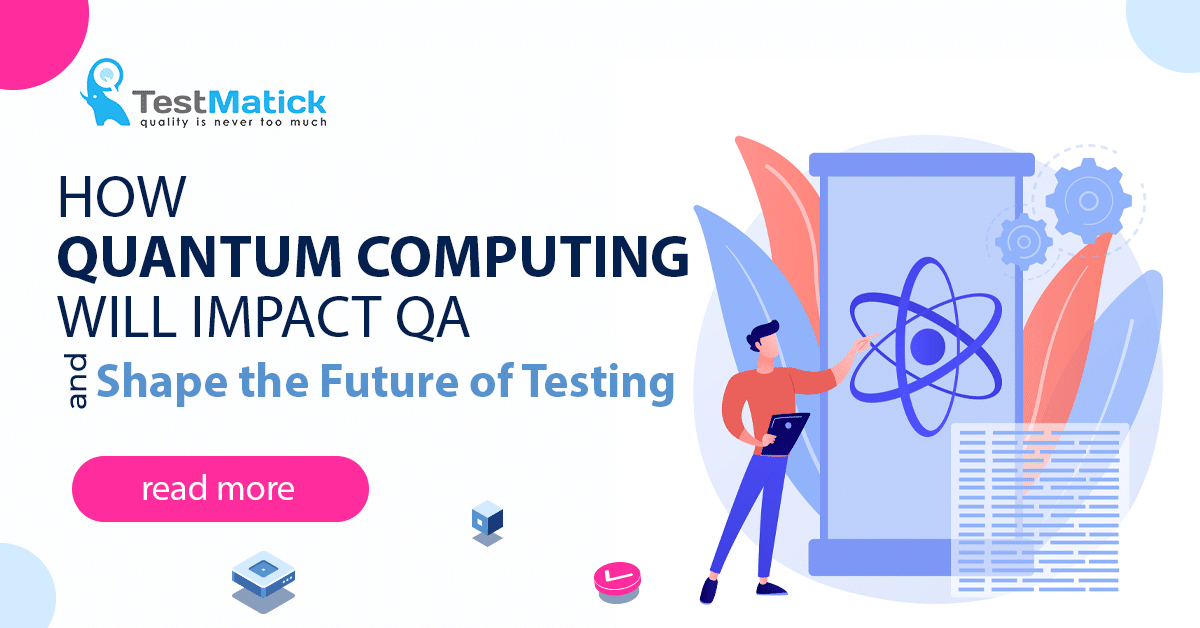
The computing world is poised for its most radical transformation since the invention of the microchip. Quantum computing – leveraging the strange yet powerful principles of quantum mechanics – is set to revolutionize how we process data. Though large-scale, fault-tolerant quantum computers are still emerging, their potential impact on software development and quality assurance (QA) is already impossible to ignore.
For software testing companies, understanding quantum computing isn’t just about curiosity – it’s about future-proofing. As quantum systems begin to intersect with mainstream technologies, QA practices must evolve to meet new challenges in security, performance, and reliability.
What Makes Quantum Computing Different?
Classical computers use bits (0s or 1s) to perform operations, while quantum computers use quantum bits, or qubits. Thanks to phenomena like superposition (where qubits can be in multiple states simultaneously) and entanglement (where qubits remain correlated even over distance), quantum computers can perform certain complex calculations exponentially faster than classical machines.
This computational power opens doors in fields like drug discovery, artificial intelligence, and material science. However, it also disrupts the assumptions on which modern software systems – and testing strategies – are built.
The Quantum Challenge to QA: A New Paradigm
Traditional QA operates on deterministic systems – given input X, you expect output Y. Quantum systems are probabilistic by nature, meaning you might get output Y most of the time, but sometimes you get Z. This changes how testers must think about validation, accuracy, and trust.
Let’s explore three critical areas where quantum computing will reshape QA.
1. Security and Cryptography Testing: Preparing for Post-Quantum Threats
Perhaps the most immediate risk posed by quantum computing is to cybersecurity. Modern encryption algorithms like RSA and Elliptic Curve Cryptography (ECC) are based on problems that are difficult for classical computers but trivial for quantum ones using algorithms like Shor’s algorithm.
What this means for QA teams:
- Post-Quantum Cryptography (PQC): Organizations like NIST are already standardizing quantum-resistant cryptographic algorithms. QA teams must adapt their test cases to these new protocols.
- Security Regression Testing: Ensure that replacing classical encryption with PQC doesn’t unintentionally break system functionality or create new vulnerabilities.
- Protocol Interoperability Testing: Evaluate whether legacy systems and new PQC-enabled components can interact without loss of data or performance.
- “Harvest Now, Decrypt Later” Risk: QA must account for attackers storing encrypted data today to decrypt it in the quantum future.
Key Testing Priorities:
- Compliance with PQC standards
- Performance and resource testing under new algorithms
- Transition management between classical and quantum-resilient encryption
2. New Testing Models and Algorithms: Embracing Probabilistic Outputs
Quantum applications will require fundamentally new testing approaches. Unlike classical test automation, quantum testing must accommodate outcomes that are non-deterministic and statistically distributed.
Emerging needs in QA include:
- Quantum State Verification: Testing quantum programs often means verifying the likelihood of getting the correct answer over many runs, not just checking for exact matches.
- Probabilistic Test Oracles: Instead of verifying fixed output, these oracles check if results fall within an expected probability range.
- Quantum Test Automation Frameworks: Tools like Qiskit (IBM), Cirq (Google), and Q# (Microsoft) will become part of the QA toolkit.
Testing challenges specific to quantum systems:
- Decoherence: Loss of quantum behavior due to noise or instability.
- Qubit Initialization & Gate Fidelity Errors: Incorrect starting states or flawed operations.
- Cross-talk and Measurement Errors: Interference between qubits and inaccuracies during readout.
To deal with these, testers must learn how to inspect quantum circuits, understand quantum logic gates, and apply quantum debugging tools that minimize state collapse.
3. Simulation and Hybrid Testing: Building Practical Quantum QA Workflows
Access to real quantum hardware remains limited. As a result, early testing of quantum software relies heavily on simulators and hybrid test setups that integrate classical and quantum components.
Strategies to manage this include:
- Simulation Tools: Platforms like IBM’s Qiskit Aer and Google’s Cirq offer simulation environments for quantum algorithms. QA teams should use these for early-stage testing and debugging.
- Hybrid Testing Models: Most real-world quantum applications will involve classical front ends and quantum back ends. QA must verify the interaction between both systems.
- Hardware-Agnostic Testing: Different quantum hardware (e.g., superconducting qubits vs. trapped ions) may behave differently. QA should ensure software compatibility across platforms.
Emerging testing approaches:
- Quantum program analysis for logical and performance issues
- Hardware-independent testing suites
- Quantum-specific benchmarks and stress-testing scenarios
Upskilling QA for the Quantum Era
To remain relevant and competitive, QA professionals must begin building foundational knowledge in quantum computing. The QA landscape will soon demand expertise that spans physics, cryptography, and advanced mathematics.
Here’s how QA teams can prepare now:
- Learn the Basics
- Study concepts like superposition, entanglement, and quantum gates.
- Explore quantum programming through open-source tools like Qiskit or Microsoft’s Q#.
- Collaborate Across Functions
- Work closely with security teams to prepare for quantum threats.
- Build cross-functional teams to explore hybrid software QA strategies.
- Invest in Long-Term R&D
- Set up pilot projects involving quantum simulators.
- Partner with academic institutions or hardware providers to stay ahead of the curve.
- Redefine Testing Roles
- Expect to see new roles like “Quantum QA Analyst” or “Quantum Security Tester.”
- Promote continuous education through workshops, certification, and community involvement.
Conclusion: The Quantum Leap Starts with QA
Quantum computing is not just another wave of tech – it’s a foundational shift in how we compute, analyze, and solve problems. For QA professionals, it introduces a new landscape where error rates, test oracles, encryption, and debugging all demand reinvention.
The good news? By preparing today – learning new tools, embracing probabilistic thinking, and leading the charge in PQC compliance – QA teams can help build the resilient, secure, and high-quality systems of tomorrow.
Quantum computing may still be on the horizon, but the time to adapt QA is now.



0 Comments