








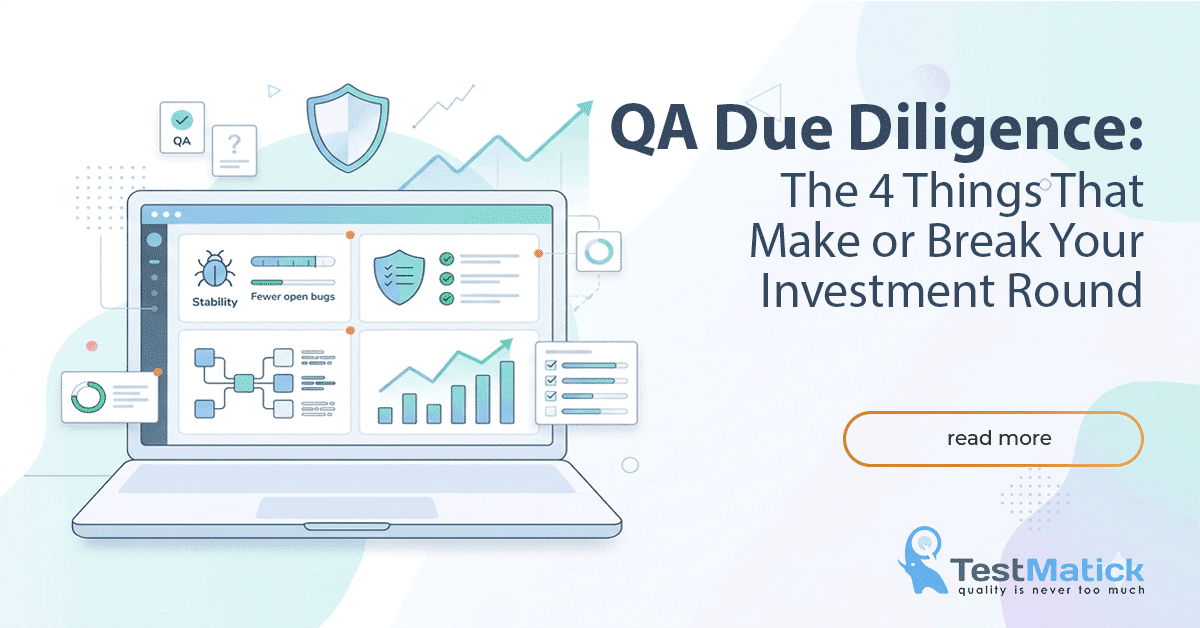
Investors are asking harder questions about software quality than they did five years ago. Technical due diligence now routinely includes a QA review — and for CTOs preparing for a Series A, B, or M&A process, that creates both a risk and an opportunity.
The risk: undisclosed QA debt or absent automation can derail a deal or reduce your valuation. The opportunity: a well-structured QA process becomes evidence of engineering maturity that raises investor confidence.
Here’s what a pre-investment QA audit actually covers, and how to get ahead of it.
Why QA Has Become a Due Diligence Item
Technical due diligence has evolved. QA was once treated as an afterthought — a box checked by confirming “the company does testing.” That’s changed for three reasons:
- Post-acquisition failures trained investors to ask more specific questions about test coverage and automation.
- CI/CD is now the baseline expectation — investors know manual-only testing doesn’t scale.
- QA debt has become a recognized valuation factor. It’s one of the most expensive forms of technical debt to remediate post-acquisition.
The takeaway: if you’re approaching a fundraise or acquisition, expect your QA process to be examined. The question is whether you’re found ready or found lacking.
The Four Areas a QA Audit Covers
Test coverage and strategy
Auditors want to understand not just how many tests you have, but what those tests actually protect. They’ll ask about coverage of critical user flows, how regression risk is managed between releases, and whether there’s a documented test strategy or just ad hoc testing.
| Red flag Reporting “80% code coverage” while having no coverage of payment flows or authentication paths. Coverage numbers mean nothing without context about what’s being covered. |
Automation maturity
Automation is table stakes at Series A or beyond. Investors know that manual-only testing creates release bottlenecks and accumulates debt. Key questions: What frameworks are in use? Is automation integrated into CI/CD or run manually? Are scripts stable or brittle?
| Red flag Automation that exists on paper but hasn’t run in months — or scripts so flaky the team disabled them. |
Defect management and release quality
Your bug tracking history is a data source investors will read. Defect trends reveal more about engineering culture than any summary document. Auditors look at mean time to detect and resolve critical defects, and the ratio of production incidents to pre-production catches. A high production-to-pre-production ratio signals weak QA gates.
Process documentation
Investors acquiring a team need confidence that QA knowledge isn’t trapped in individual engineers’ heads. They’ll look for written test plans, defined release sign-off processes, and evidence that QA is involved in requirements review — not just at the end of the sprint.
| Red flag “We don’t write test plans, we just test.” This answer immediately signals a QA practice that won’t survive scaling or acquisition integration. |
How CTOs Can Prepare Proactively
The worst time to discover your QA gaps is during investor diligence. Most gaps are fixable if you identify them 3–6 months before a process begins.
Commission an independent audit
An internal self-assessment has limited credibility with investors — and limited usefulness to you, because internal teams rationalize their own practices. An independent third-party audit gives you an honest baseline and documentation you can share with investors as evidence of due diligence done.
The audit should produce a maturity assessment, a prioritized gap analysis focused on issues most likely to surface in diligence, and a remediation roadmap.
Address high-visibility gaps first
Not all QA gaps are equal in an investor’s eyes. Prioritize: anything that could surface as a production incident during the diligence period, missing documentation (fast to create, strong impression), automation coverage of core user flows (first thing technical reviewers check), and security testing history.
Build a QA evidence package
Prepare a concise summary of your QA posture: testing strategy, automation coverage metrics, recent defect trends, and security testing history. Investors are looking for evidence of intentionality and process — not perfection.
| Practical tip Frame your QA evidence around risk management, not activity. “Our automation suite catches 94% of regressions before staging” lands better than “we have 1,200 automated tests.” |
Final Thoughts
For CTOs approaching a fundraise or acquisition, QA readiness is a due diligence item with direct implications for deal outcome and valuation. The companies that come through strongest are those that treated quality as a strategic investment — and can demonstrate it with documentation, metrics, and a credible independent assessment.
If you’re 6 months or more from a fundraise, now is the right time to commission an independent QA audit and address what it surfaces. If you’re closer, focus on documentation and closing the highest-visibility gaps first.




0 Comments