








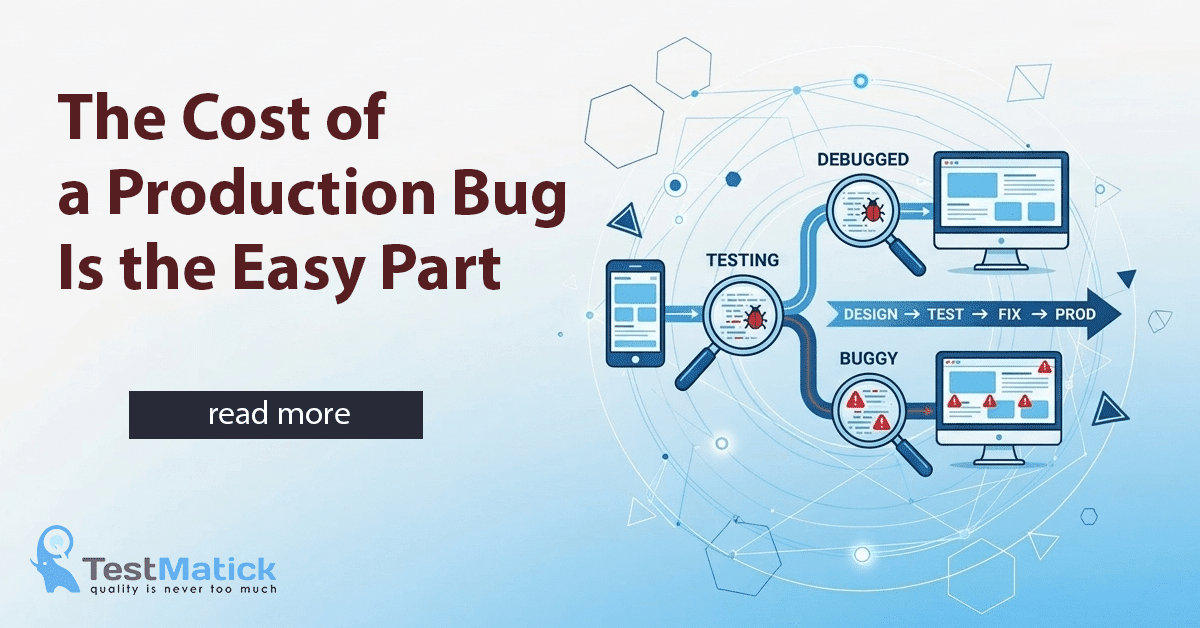
Every engineering team knows the rule. A bug found in production costs significantly more to fix than one caught during development. IBM put numbers to it decades ago — four to five times more expensive after release than during design, and up to 100 times more than if caught during requirements. The figures have been updated, cited, and recited so often they’ve become background noise.
And yet bugs keep reaching production.
Not because teams don’t know the rule. Because knowing the cost of something doesn’t automatically change the conditions that produce it. The real question isn’t how much a production bug costs. It’s why, despite everyone knowing the answer to that question, the problem persists.
The math is well understood. The system is not.
The cost calculation for a production bug is straightforward: developer time to diagnose and fix, QA time to retest, deployment overhead, potential downtime, customer support volume, and — depending on the product — regulatory exposure or reputational damage. Add it up and the number is always larger than anyone wanted.
But the conditions that allow bugs to reach production in the first place are harder to quantify and easier to ignore. They’re not usually the result of negligence. They’re the result of accumulated pressure, reasonable-looking tradeoffs, and systems that weren’t designed to catch certain types of failures.
Release deadlines compress testing windows. Features are handed to QA late in the sprint, leaving insufficient time for thorough coverage. Test environments don’t accurately reflect production conditions — different data volumes, different integrations, different user behaviors. Edge cases are deprioritized in favor of happy path coverage. Regression suites grow stale as the product evolves faster than the tests.
None of these are dramatic failures. They’re the ordinary friction of moving fast. But ordinary friction, compounded over enough releases, produces the conditions where production bugs are not an anomaly — they’re an inevitability.
The bugs that reach production aren’t random
When a bug makes it to production, the instinct is to treat it as a one-off — an edge case nobody could have predicted, a failure in an obscure integration, bad luck. Occasionally that’s true. More often, there’s a pattern.
Production bugs cluster around predictable areas: recently changed code that wasn’t fully regression tested, integrations with third-party systems that behave differently under real conditions, features that interact with each other in ways that weren’t mapped during testing, and user flows that work correctly in isolation but break under specific combinations of state.
These aren’t unknowable. They’re the areas where testing coverage is thinnest — either because the team ran out of time, because the complexity wasn’t fully understood, or because the test suite hadn’t kept pace with the product.
Amazon’s famously costly outages — the company reportedly loses around $220,000 per minute during peak traffic disruptions — aren’t caused by failures in basic functionality. They’re caused by cascading failures in complex distributed systems under load conditions that are difficult to simulate in pre-production environments. The bug that caused Knight Capital Group to lose $440 million in 45 minutes in 2012 was a deployment error — untested code that activated a dormant system and sent the trading algorithm into an uncontrolled spiral. The code itself wasn’t new. The failure was in the process around it.
Why the cost argument alone doesn’t change behavior
If the 4-5x cost multiplier were sufficient to change behavior, teams would have solved this problem by now. They haven’t, which suggests the cost argument, while true, is missing something.
Part of the problem is timing. The cost of a production bug is paid in the future, by people who may not be the same ones making today’s tradeoffs. The decision to skip regression testing on a Friday afternoon to hit a release window is made under immediate pressure. The cost shows up weeks later as a support ticket spike, a customer escalation, or a regulatory inquiry. The connection between the decision and the consequence is real but diffuse.
Part of the problem is visibility. A bug that doesn’t exist yet doesn’t show up on any dashboard. The cost of prevention is concrete and immediate — it requires time, resources, and process overhead. The cost of the bug it prevents is hypothetical until it isn’t. Organizations consistently underinvest in hypothetical costs, even when the historical data is clear.
And part of the problem is that “test more” isn’t actually the answer. Adding testing capacity without changing what gets tested, when, and how doesn’t reliably reduce production bugs. It may improve confidence without improving outcomes, particularly if the additional testing covers the same well-understood paths that were already working.
What actually reduces production bugs
The teams that consistently keep production bug rates low tend to share a few characteristics that go beyond test coverage numbers.
They involve QA earlier. Not as a gate at the end of the development cycle, but as a participant in requirements and design. Bugs caught before a line of code is written don’t require developer time to fix at all. The cost isn’t 4-5x less — it’s effectively zero.
They maintain test environments that reflect production reality. This is harder than it sounds — production data volumes, real third-party integrations, representative user behavior patterns. But testing in an environment that doesn’t resemble production is, at best, incomplete.
They treat regression as a continuous process, not a periodic one. Every release changes the product. The test suite needs to change with it, or coverage degrades invisibly over time.
And they track where bugs are actually coming from. Not just severity and volume, but origin — which part of the development process produced them, which areas of the product they cluster in, whether the pattern is shifting over time. This data is what turns “test more” into “test this, differently.”
The expensive part isn’t the fix
When a critical bug reaches production, the fix is usually the smallest item on the bill. The developer patches the code. The QA team retests. The deployment goes out.
What doesn’t show up in the ticket is the customer who experienced the failure and quietly switched to a competitor. The support team that spent a week on an issue that shouldn’t have existed. The release that was delayed because the team was firefighting instead of building. The regulatory body that noticed the pattern in complaint data and opened an inquiry.
These are the real costs of production bugs — not the hours spent fixing them, but the compounding consequences of shipping something that wasn’t ready. And unlike the fix itself, these costs don’t appear on a single line item. They distribute across the business, quietly, over time.
That’s what makes them hard to account for — and easy to underestimate.
The rule about production bugs costing more is correct. It’s just not the whole story.





0 Comments