







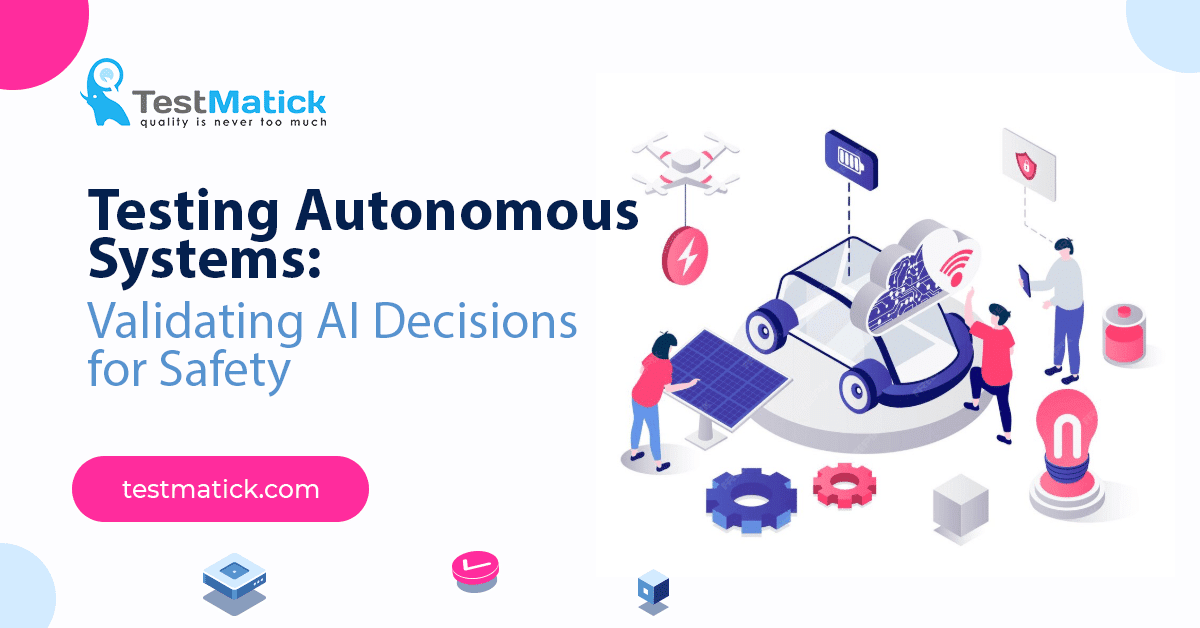
The rise of autonomous systems such as drones, self-driving cars, and industrial robots is transforming industries and everyday life. From delivery drones that reduce logistics costs, to autonomous vehicles that aim to eliminate human error, to robotic assistants in manufacturing and healthcare – these technologies are powered by artificial intelligence (AI) and machine learning (ML).
Yet, with great innovation comes a fundamental challenge: how can we validate AI-driven decision-making in unpredictable and safety-critical environments?
Testing autonomous systems is no longer just about verifying functionality. It requires addressing uncertainty, adaptability, real-time decision-making, and human safety. In this article, we will explore the unique testing challenges of autonomous systems, strategies for validating AI decision-making, and why specialized testing services are crucial to making autonomy trustworthy.
The Core Challenge: AI in Uncertain Environments
Unlike traditional software, autonomous systems do not follow static, predefined rules. They rely on complex neural networks and decision-making algorithms trained on massive datasets. This means their behavior is probabilistic, not deterministic.
For example:
- A self-driving car approaching an intersection must interpret sensor inputs, recognize pedestrians, and predict intentions of other drivers.
- A drone navigating urban airspace must dynamically adjust to wind, GPS signal loss, or unexpected obstacles.
- A robotic arm in a factory must react to variations in object placement or unforeseen human presence nearby.
In all these scenarios, AI decisions are influenced by uncertain, dynamic, and incomplete data. Traditional test cases are insufficient because it’s impossible to enumerate every possible situation.
Why Safety-Critical Testing Matters
When autonomous systems fail, the consequences can be catastrophic. A minor software bug in an e-commerce platform might frustrate users, but a misjudgment by a self-driving car could cause a fatal accident. Safety-critical testing must therefore focus on:
- Functional correctness – Does the system perform as intended?
- Resilience under uncertainty – Can it handle incomplete or noisy data inputs?
- Fail-safe behavior – Does it degrade gracefully or halt safely when it cannot decide?
- Compliance with standards – Adherence to ISO 26262 (automotive), DO-178C (avionics), IEC 61508 (industrial safety), and other regulatory frameworks.
Testing must go beyond pass/fail results and instead validate trustworthiness – ensuring that the system behaves reliably across both expected and unexpected conditions.
Key Testing Challenges for Autonomous Systems
- Complex Sensor Inputs
Autonomous systems rely on lidar, radar, GPS, ultrasonic, and camera feeds. Testing must validate how the system fuses these diverse data sources into a coherent understanding of the environment. Sensor inaccuracies, blind spots, or adversarial inputs can distort perception. - Scenario Explosion
The number of possible driving, flying, or operating scenarios is practically infinite. Exhaustive testing is impossible. A drone may encounter unexpected weather conditions; a car may face rare but dangerous events like a child running into the street at night. - AI Explainability
Deep learning models are often “black boxes.” Understanding why the system made a decision is essential for debugging and safety validation. Testing must include explainability mechanisms. - Real-Time Constraints
Autonomous systems must make split-second decisions. Testing should validate latency, processing speed, and response under time-critical conditions. - Human Interaction
Many autonomous systems share space with humans. Testing must include unpredictable human behaviors and ensure the system adapts appropriately without compromising safety.
Approaches to Testing AI-Driven Decision-Making
Given these challenges, testing autonomous systems requires a multi-layered strategy that combines simulation, real-world testing, and formal verification.
1. Simulation-Based Testing
High-fidelity simulators allow testers to expose AI systems to millions of virtual scenarios that would be too costly or dangerous in reality. For example:
- A self-driving car simulator can replicate bad weather, traffic jams, or unusual pedestrian behavior.
- A drone simulator can model wind turbulence or GPS spoofing attacks.
Simulations provide scalable coverage and allow stress-testing rare edge cases.
2. Hardware-in-the-Loop (HIL) Testing
HIL testing integrates real hardware (sensors, actuators, controllers) with virtual environments. This ensures that both the physical components and AI software are validated under controlled but realistic conditions.
3. Formal Verification
Mathematical methods can prove that algorithms satisfy critical safety properties. For instance, verifying that a robotic arm will never exceed a speed limit when near humans, regardless of sensor inputs. Formal methods help build confidence in fail-safe behavior.
4. Adversarial Testing
AI models are vulnerable to adversarial inputs – subtle perturbations that cause misclassification. Testing must include robustness checks against adversarial attacks (e.g., confusing a stop sign for a speed-limit sign).
5. Field Testing with Safety Drivers/Operators
While simulations are essential, real-world testing is unavoidable. For autonomous cars, this includes controlled test tracks and public road trials with safety drivers. For drones, this involves designated airspace testing with backup pilots. Field validation ensures the system’s decisions translate correctly outside lab conditions.
Safety Under Uncertainty: Building Trust in AI
Testing must address not only functionality but also how systems respond when they don’t know what to do. Key techniques include:
- Uncertainty Quantification (UQ): AI models can be designed to output confidence levels. If confidence drops below a threshold, the system should hand over control or execute a fail-safe action.
- Redundancy and Failover Mechanisms: Autonomous systems should have backup strategies – like secondary sensors, manual override, or emergency stop capabilities.
- Ethical Decision Testing: Scenarios like unavoidable collisions require testing ethical decision frameworks to ensure consistent, transparent responses.
Industry Standards and Regulations
Testing autonomous systems cannot be isolated from compliance. Major industry standards include:
- Automotive: ISO 26262 (functional safety), ISO/PAS 21448 (Safety of the Intended Functionality – SOTIF), UNECE regulations for autonomous vehicles.
- Aerospace: DO-178C (airborne software safety), ASTM standards for drone operations.
- Industrial Robotics: IEC 61508 and ISO 10218.
A strong testing program must integrate these standards with practical test execution.
The Role of Specialized Testing Companies
For organizations developing autonomous systems, partnering with a software testing company brings several advantages:
- Expertise in AI/ML validation – Specialized testers understand the nuances of testing non-deterministic, data-driven algorithms.
- Scalable simulation and automation – Access to advanced test frameworks that can generate and run thousands of scenarios efficiently.
- Compliance knowledge – Experience with safety-critical certification processes ensures faster approval cycles.
- Independent verification – Third-party testing provides unbiased results, which regulators and customers trust more.
Ultimately, specialized testing helps accelerate time-to-market while ensuring that safety and reliability are never compromised.
Conclusion
Autonomous systems promise to reshape industries and improve human life, but only if they can be trusted to make safe, reliable decisions under uncertainty. Testing these systems is one of the most complex challenges in modern QA – requiring simulations, adversarial analysis, formal verification, and real-world trials.
By rigorously validating AI-driven decision-making and aligning with global safety standards, testing companies play a vital role in building trust in drones, self-driving cars, and robotics. For businesses developing autonomous systems, partnering with a software testing company experienced in AI and safety-critical environments is not just an option—it’s an essential step toward delivering innovation that is both transformative and safe.



0 Comments